

If customers search for your company online, will they find the same name, address, and phone number everywhere? Or will one directory display an old address, another show a disconnected number, and a third use a previous business name? These differences may look minor, but they can make it harder for people and search engines to identify, trust, and contact your business.
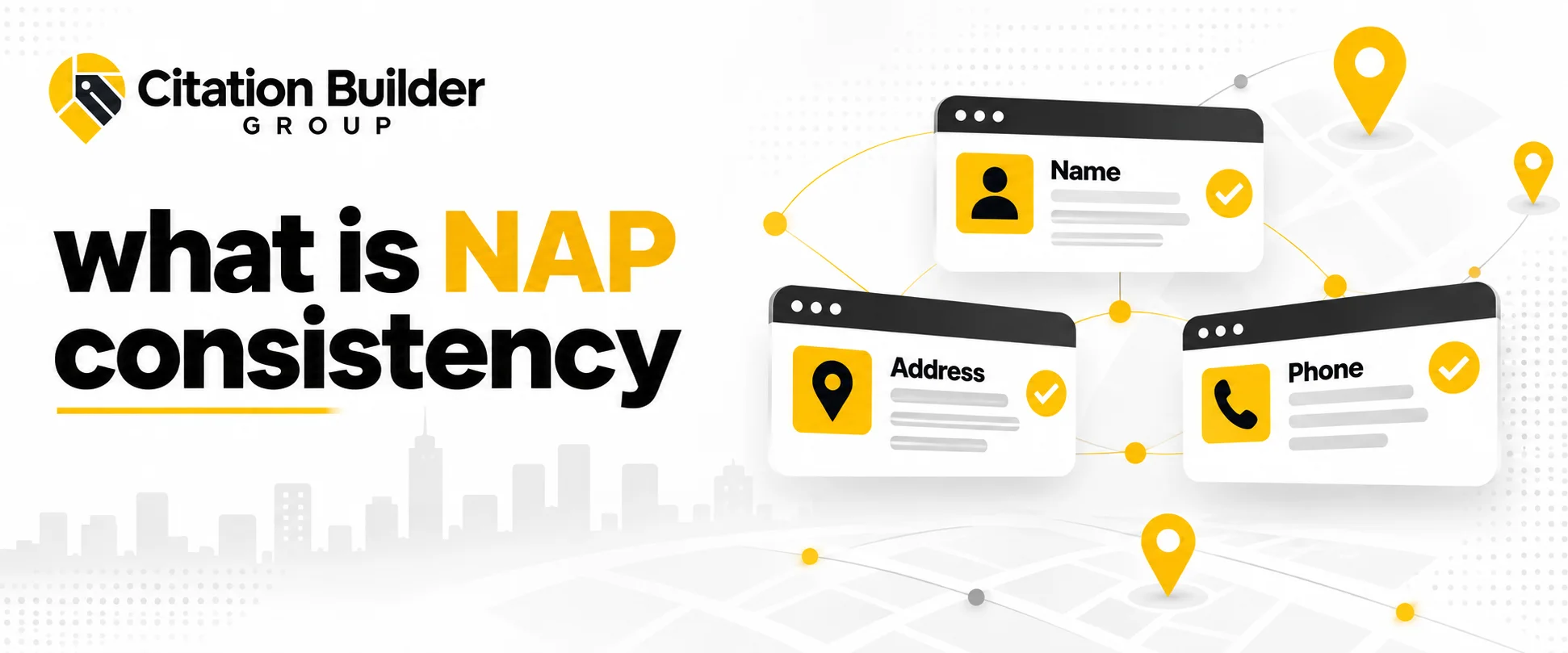
So, what is NAP consistency? NAP consistency means keeping a business’s Name, Address, and Phone number accurate and uniform wherever the business appears online. These details may be displayed on the company website, Google Business Profile, social networks, maps, apps, local directories, industry platforms, and other citation sources. The information should describe the same real-world business entity across every relevant listing.
Maintaining accurate listings is a foundational part of local search marketing. It helps search engines connect different mentions of a business, reduces friction for potential customers, and creates a cleaner digital footprint. Whether you operate from one office or manage hundreds of locations, reliable NAP information makes your local presence easier to understand.
This guide explains how consistency works, why errors appear, how they affect visibility, and what you can do to audit and correct your business information.
What Does NAP Mean in Local SEO?
NAP stands for:
- Name: The official public-facing name of the business.
- Address: The complete physical location, including applicable suite or unit details, city, region, and postal code.
- Phone: The primary local telephone number customers should use to reach the business.
These details form a basic business identity. When they appear on another website, they can create a local citation. If you are new to this subject, start with our detailed explanation of what local citations are and how they support local visibility.
NAP is not the only information a listing may contain. A full profile might also include a website URL, opening hours, business categories, photos, services, payment options, or a description. However, name address phone consistency remains especially important because these three fields help distinguish one business entity and location from another.
What Is NAP Consistency in Practice?
In practice, what is NAP consistency supposed to look like? It means that the core details on your website and important third-party profiles refer clearly to the same business. Search engines should not have to guess whether “Oak Street Dental,” “Oak St. Dental Clinic,” and “Oak Street Family Dentistry” are separate companies or different versions of one company.
Consistency does not always require every character to be identical. Common formatting differences—such as “Street” versus “St.” or “Suite” versus “Ste.”—will often be understood. The more serious problems are factual contradictions: an outdated telephone number, an incorrect street number, a former company name, or two listings with different information for the same location.
A practical standard is to maintain one approved master record and use it when creating or updating listings. This makes NAP data accuracy easier to control and gives employees, agencies, and partners a reliable source of truth.
Examples of consistent and inconsistent NAP details
Suppose the correct business information is:
Bright Path Accounting LLC
125 Market Street, Suite 400, Austin, TX 78701
(512) 555-0188
A listing that says “125 Market St., Ste. 400” is generally a formatting variation, not necessarily a factual error. A listing that says “215 Market Street,” uses an old phone number, or omits the suite when it is needed for deliveries may create confusion.
The goal is to publish consistent business information that customers can use and platforms can confidently associate with the correct location.
Why NAP Consistency Matters for Local SEO
Search engines gather information from many sources to understand a local business. Your website is important, but it is not the only signal. Directory profiles, mapping services, review platforms, social pages, and other third-party mentions can reinforce—or contradict—the information you provide.
Strong local SEO NAP management supports several practical outcomes.
It helps search engines understand your business
When credible sources repeatedly show the same core details, search engines can more easily connect those mentions with one entity. Clear information supports confidence about where the company operates and how users can contact it. Consistency alone does not guarantee rankings, but it strengthens the foundation on which other local SEO work is built.
It creates a better customer experience
Customers often move between platforms before taking action. They may find a business in search results, read reviews on another site, and then use a directory to call or request directions. If the phone number or address changes between those touchpoints, the customer may abandon the journey or contact a competitor.
Accurate information makes it easier to call, visit, book, or buy. In this sense, NAP maintenance is not only an SEO task; it is also part of customer service and conversion optimization.
It reduces lost leads and operational problems
An incorrect number can send valuable calls nowhere. An outdated address can result in missed appointments, failed deliveries, and poor reviews. Duplicate listings can split reviews and leave customers uncertain about which profile is official. Improving NAP data accuracy helps prevent these avoidable losses.
It supports a trustworthy online presence
People expect established businesses to keep their public details up to date. A clean and coherent digital footprint feels more professional than a collection of conflicting profiles. It also helps partners, journalists, suppliers, and navigation systems find the right information.
NAP Consistency and Local Citations
Local citations are online mentions of a business, often containing some or all of its NAP details. They may appear in structured directories or within articles, local news, membership pages, event pages, and other content.
Structured listings usually place business details into labeled fields. Unstructured mentions include the information naturally within a page. Both can contribute to a business’s online presence, but they require different discovery and correction methods. Our guide to structured vs unstructured citations explains the distinction in more detail.
It is also useful to understand that citations and links are related but not interchangeable. A citation can mention a business without linking to its website, while a backlink is a clickable link from another site. Read local citations vs backlinks to see how each fits into an effective search strategy.
For citation building to work well, submissions should begin with verified data. Publishing the same mistake across dozens of directories multiplies the cleanup work. A quality-first process focuses on relevant sources, complete profiles, duplicate checks, and consistent business information rather than submission volume alone.
Common Causes of NAP Inconsistency
Even well-managed companies develop inaccurate listings over time. The most common causes include:
- Moving to a new office or storefront without updating older profiles.
- Changing a phone number, call-tracking setup, or telephone provider.
- Rebranding, merging, or changing the legal or public business name.
- Creating duplicate profiles for the same location.
- Allowing different employees or vendors to use different source data.
- Using an old website footer or contact page as a reference.
- Incorrect information collected and republished by third-party platforms.
- Variations created during manual entry, data imports, or automated distribution.
- Closing one location while its old listings remain live.
- Using a central phone number on some profiles and a location number on others.
Multi-location businesses face additional complexity. Each branch needs a distinct, stable record, and the address and telephone number for one location must not be assigned to another. Without a central process, even a small change can spread inconsistently across many platforms.
How to Audit NAP Consistency Step by Step
If you understand what is NAP consistency but are unsure where to start, use the following workflow.
1. Create a master NAP record
Write down the approved business name, full address, local phone number, and canonical website URL. Add opening hours, primary category, short description, and location page URL to make the record more useful. Confirm every field with someone who knows the current operational details.
For multiple locations, create one row per branch in a controlled spreadsheet or database. Assign responsibility for approving future changes.
2. Check your own website first
Review the contact page, location pages, footer, header, schema markup, appointment pages, and downloadable documents. Your website should present a clear source of truth. Make sure the location data visible to users agrees with the structured data supplied to search engines.
3. Review major profiles and directories
Search the business name, address, and phone number separately. Check prominent search, map, review, social, industry, and local directory platforms. Record the profile URL, status, displayed data, login ownership, and required correction.
The citation builder service provides an overview of manual citation building, audits, cleanup, and directory listing support.
4. Find duplicate and legacy listings
Search previous names, old addresses, former phone numbers, and common misspellings. Duplicates may not appear when you search only the current information. Decide whether each incorrect profile should be updated, merged, marked closed, or removed according to the platform’s rules.
5. Prioritize corrections
Start with your website and the platforms most likely to influence discovery or customer action. Then address important industry and geographic directories, followed by lower-priority sources. Correcting one authoritative profile is often more valuable than creating many weak listings.
6. Document every change
Track the submission date, status, login details, live URL, and follow-up date. Some edits require verification or manual review. Documentation prevents duplicated work and makes future maintenance faster.
7. Monitor the results
Recheck listings after changes go live and schedule regular reviews. Monitoring is particularly important after a move, rebrand, acquisition, new-location launch, or telephone change. NAP data accuracy is an ongoing business process, not a box to tick once and forget.
How to Fix Inconsistent Business Information
Begin by claiming or gaining access to the most important profiles. Submit the approved details and complete any verification steps. Where duplicates exist, follow each platform’s procedure rather than creating another profile. Keep evidence such as business registration records, utility documents, signage photos, or website contact information available if a platform requests proof.
Avoid changing multiple identity elements without a plan. If a business moves and rebrands simultaneously, document the relationship between the former and current entity. Update the website, high-priority listings, social pages, and major data sources in a coordinated sequence.
Professional assistance can be helpful when the footprint is large, duplicates are widespread, or internal teams lack time to contact platforms individually. Citation Builder Group’s citation and local SEO services include support for manual submissions, listing optimization, citation audits, cleanup, and reporting.
NAP Best Practices for Single and Multi-Location Businesses
Use these principles to protect name address phone consistency over time:
- Choose one approved public business name and avoid adding marketing keywords to it unless they are genuinely part of the name.
- Use a real, customer-facing address that follows the relevant platform’s guidelines.
- Assign a stable local phone number to each eligible location where practical.
- Create a dedicated website page for every location and display its correct details.
- Keep a centralized master record with controlled access and a change history.
- Search for existing profiles before creating new ones.
- Give each listing the most accurate primary and secondary categories.
- Update key platforms promptly when business information changes.
- Audit important citations periodically for edits, duplicates, and closures.
- Preserve login credentials and verification ownership so future corrections are possible.
Call-tracking requires particular care. If you use tracking numbers, implement them in a way that preserves the primary business number and follows platform guidelines. The aim is to measure performance without creating contradictory identity signals or confusing returning customers.
Countries Supported by Citation Builder Group
Citation requirements vary by country. Directory popularity, address formats, telephone conventions, language, and verification methods are not the same everywhere. A location-focused approach helps businesses choose sources that are relevant to the market they actually serve.
Citation Builder Group provides citation-building support for businesses in:
- United States
- United Kingdom
- Canada
- Australia
- South Africa
- Netherlands
- Germany
- Singapore
- New Zealand
- France
- Spain
- Italy
- Turkey
- Greece
- Sweden
- Switzerland
- Austria
- Belgium
- Portugal
For every country, the same principle applies: establish the correct record before publishing it. Then select suitable global, national, local, and industry-specific platforms. This combination supports stronger local SEO NAP signals than using an identical, untargeted directory list for every market.
How Often Should You Check NAP Data?
There is no single schedule for every organization. A stable single-location business may perform a thorough audit every six to twelve months, with lighter checks in between. A growing multi-location brand may need monthly monitoring and an immediate review whenever operational details change.
You should also conduct an audit after:
- A move, rebrand, merger, or acquisition.
- A new phone system or call-tracking implementation.
- Opening, relocating, or closing a branch.
- A sudden decline in calls, direction requests, or local visibility.
- Discovering duplicate or unauthorized profiles.
- Changing the team or agency responsible for local listings.
The right frequency depends on how quickly your information changes and how valuable local discovery is to the business.
Frequently Asked Questions
What is NAP consistency in simple terms?
What is NAP consistency? It is the practice of keeping your business name, address, and phone number accurate and aligned across your website and relevant online platforms. Minor formatting differences are usually less concerning than contradictory facts such as an old number or wrong address.
Does NAP information have to match exactly everywhere?
The information should clearly identify the same business and location. Normal abbreviations and formatting variations are often understood, but the underlying facts must be correct. Focus first on factual name address phone consistency, then standardize presentation where practical.
Can incorrect NAP details hurt local SEO?
Incorrect details can weaken the clarity of a business’s online footprint and create poor customer experiences. They may contribute to lost calls, failed visits, duplicates, and uncertainty about the correct location. Accurate data supports local SEO, but it should be combined with a complete website, relevant citations, reviews, helpful content, and other local signals.
Is NAP consistency a ranking factor?
It is best viewed as a foundational local search practice rather than a standalone shortcut to higher rankings. Search engines use many signals. Maintaining accurate business information helps them and potential customers understand the business, while severe inconsistencies can undermine trust and usability.
What is the fastest way to improve NAP data accuracy?
Create a verified master record, correct your website, claim key listings, remove or merge duplicates, and then work through relevant directories in priority order. Keep a report of every update and recheck pending changes.
Should service-area businesses publish their home address?
Follow the guidelines of each platform and protect private information. Where a platform allows service-area businesses to hide an address, configure the profile appropriately. The details you publish should be truthful and should not use virtual or misleading locations merely to target additional areas.
Build a More Reliable Local Search Presence
Understanding what is NAP consistency is the first step; maintaining it is where businesses gain lasting value. A clean master record, accurate location pages, relevant citations, duplicate control, and regular monitoring give both customers and search platforms a clearer picture of who you are and where you operate.
If your listings contain outdated details—or you need to build accurate citations for a new location—explore Citation Builder Group’s professional citation building services. A careful, manual approach can help you establish consistent business information, improve customer journeys, and create a stronger foundation for local visibility.