
When building local business citations, it is easy to assume that more listings will always produce better results. A business may submit its name, address, and phone number to hundreds of directories and expect its local visibility to improve. However, the citation quality vs quantity debate is more complex than simply counting how many times a business appears online.
A smaller number of accurate, relevant, and complete citations can provide more value than a large collection of outdated or low-quality listings. Search engines and potential customers need reliable information, not repeated business details on directories that have little connection to the company’s location, industry, or audience.
An effective citation campaign should therefore balance coverage with quality control. Businesses need enough listings to establish a credible local presence, but every submission should have a clear purpose. Directory authority, geographic relevance, industry relevance, profile completeness, and NAP consistency all influence the value of a citation.
This guide examines citation quality vs quantity, explains how to evaluate directory listing quality, and provides a practical framework for creating a sustainable local citation strategy.
What Is a Local Citation?
A local citation is an online mention of a business that normally includes its name, address, and phone number. These details are commonly referred to as NAP information. A citation may also include the company’s website, business category, opening hours, description, images, social profiles, and service areas.
Citations can appear on business directories, local portals, industry-specific websites, mapping platforms, chambers of commerce, review websites, professional associations, and other trusted online resources.
If you need a more detailed introduction to this subject, read what are local citations before deciding which directories should be included in your campaign.
Citations help search engines and users verify important information about a business. When multiple trusted sources display consistent details, they contribute to a clearer online business identity. When the information is contradictory, incomplete, or duplicated, both search engines and customers may struggle to determine which details are correct.
This is why citation quality vs quantity is an important consideration. The existence of a listing is only one part of its potential value. The source, accuracy, relevance, and completeness of that listing matter as well.
Citation Quality vs Quantity: Understanding the Difference
Citation quantity refers to the total number of online listings or mentions a business has. A quantity-focused campaign aims to place the business on as many directories as possible, sometimes without carefully examining each website.
Citation quality refers to the usefulness and reliability of each listing. A high-quality citation generally appears on a legitimate, established, geographically relevant, or industry-relevant website. It also contains accurate and complete business information.
The citation quality vs quantity question should not be interpreted as a choice between having one excellent citation or hundreds of listings. Most businesses need a reasonable breadth of coverage. The objective is to gain that coverage through directories that support visibility, trust, and customer discovery.
A quality-focused citation campaign considers:
- Whether the directory is relevant to the business’s country or city
- Whether the website serves the company’s industry
- Whether the directory contains genuine and maintained business profiles
- Whether the business information can be completed accurately
- Whether the listing is likely to be indexed and discovered
- Whether customers actually use the platform
- Whether duplicate or incorrect profiles already exist
- Whether the listing offers useful features such as categories, descriptions, images, and website links
Quantity becomes helpful after these quality requirements have been addressed. It should expand relevant coverage rather than introduce unnecessary or inaccurate listings.
Why More Citations Are Not Automatically Better
A business can appear on hundreds of websites and still have a weak citation profile. This can happen when the listings are created on irrelevant directories, contain incomplete information, or present conflicting NAP details.
A quantity-first approach may create several problems.
Inconsistent business information
Submitting listings without a verified master record can result in variations of the business name, old addresses, incorrect phone numbers, and inconsistent website URLs. These variations can make it harder to maintain a reliable business identity.
To understand why standardization matters, see what is NAP consistency and use a single approved version of the company’s core information for every submission.
Low-relevance directory profiles
A directory may accept a business submission even when the website has no meaningful relationship with the company’s location or industry. Acceptance does not automatically make the listing valuable.
For example, a specialist medical supplier may gain more relevant visibility from an established healthcare directory than from numerous generic websites containing unrelated businesses from different countries.
Duplicate listings
Bulk submissions can create new profiles without checking whether the business already has a listing. This may leave multiple versions of the same company, each with different information. Duplicate profiles can also divide reviews, confuse customers, and make future updates more difficult.
Incomplete profiles
Automated or rushed submissions often include only basic NAP details. They may omit categories, descriptions, opening hours, images, service areas, and other fields that help customers understand the business.
Difficult maintenance
Every citation may eventually require an update. A company that changes its address, phone number, business name, or operating hours must identify and correct existing listings. Hundreds of low-value profiles can create unnecessary maintenance work.
These risks show why the citation quality vs quantity decision should begin with accuracy and relevance.
What Makes a High-Quality Citation?
Not every directory provides the same value. Businesses should evaluate several factors before including a website in their citation campaign.
Geographic relevance
A directory that serves the company’s actual market can strengthen its local presence and place the business in front of an appropriate audience. A business in Canada, for example, should prioritize respected Canadian platforms and relevant directories for its province or city.
Geographic relevance can operate at different levels:
- International platforms with recognized local business sections
- National directories
- Regional and state directories
- City and community portals
- Local chambers of commerce
- Country-specific trade associations
High quality citation sites do not always need to be global platforms. A credible city or regional directory may be valuable because it is highly relevant to the location being targeted.
Industry relevance
Industry directories can help connect a business with people actively searching for a particular product, profession, or service. Legal firms, healthcare providers, restaurants, contractors, real estate companies, and other specialized businesses can benefit from suitable niche platforms.
Citation relevance and authority should be considered together. A globally recognized directory may provide broad credibility, while a smaller industry directory may provide precise topical relevance.
Website credibility
A useful directory should appear legitimate, maintained, and designed for real users. It should contain structured business profiles, clear navigation, appropriate categories, and accurate location data.
Warning signs may include excessive advertising, irrelevant content, large numbers of broken pages, poorly moderated submissions, or profiles that appear to have no purpose beyond creating links.
Profile completeness
Directory listing quality also depends on how much accurate information can be added. A complete profile provides a better experience for potential customers and creates a more detailed representation of the business.
Where supported, a listing should include:
- Correct business name
- Physical address or approved service-area information
- Local phone number
- Primary website URL
- Appropriate primary and secondary categories
- Opening hours
- Business description
- Products or services
- Logo and relevant images
- Social media profiles
- Payment or accessibility information
- Accurate map location
Examples of different listing formats can be found in local citation examples.
How to Evaluate Citation Relevance and Authority
Citation relevance and authority cannot be measured by one metric alone. A directory’s perceived domain strength may be useful for initial evaluation, but it should not be the only selection criterion.
Consider the following questions before submitting a business:
- Does the directory serve the business’s country, region, or city?
- Does it include a suitable business category?
- Does the website maintain legitimate company profiles?
- Are directory pages visible in search results?
- Is the platform recognized by local customers?
- Can the listing include complete and accurate business information?
- Does the website appear active and regularly maintained?
- Does the directory moderate submissions?
- Are existing listings accurate, or does the site contain obvious spam?
- Will the listing help customers find or evaluate the business?
This assessment produces a more practical understanding of citation relevance and authority than relying exclusively on a third-party authority score.
A relevant niche directory should not automatically be rejected because it has a smaller audience than a major platform. If it serves the correct sector and geographic market, it may contribute to a diverse and purposeful citation profile.
Directory Listing Quality: The Details That Matter
Directory listing quality is determined partly by the website and partly by the way the profile is created. Even a listing on a reputable platform can underperform if the information is inaccurate or incomplete.
Accurate NAP details
The business name, address, and phone number should follow the company’s approved format. Avoid unnecessary keyword additions to the business name unless they are genuinely part of the registered or publicly used name.
Correct business categories
Categories help platforms and customers understand what the business offers. Select the closest available primary category and use additional categories only when they accurately describe real services.
A useful business description
Descriptions should explain what the company does, who it serves, and where it operates. Avoid repeating the same keyword unnaturally. A clear description written for potential customers is more useful than a paragraph created solely for search engines.
A consistent landing page
Listings should normally link to the most relevant official page. For a single-location company, this may be the homepage. A multi-location company may need a dedicated location page for each branch.
Understanding local citations vs backlinks can help clarify why citation accuracy and business verification remain important even when a directory link does not pass traditional link authority.
Images and supporting information
Logos, photographs, hours, services, and other optional fields can make a profile more informative. They may also help the listing appear legitimate and complete to users visiting the directory.
Structured and Unstructured Citations
A balanced local citation strategy can include both structured and unstructured mentions.
Structured citations display business information in predefined fields. Directory profiles commonly have separate fields for the company name, address, phone number, website, and category.
Unstructured citations mention the business within ordinary content. These mentions may appear in local news articles, blog posts, event pages, sponsorship announcements, association pages, or community resources.
The distinction is explained further in structured vs unstructured citations.
In the context of citation quality vs quantity, both forms should be evaluated for relevance and accuracy. A trusted local publication mentioning the business naturally may be more useful than many profiles on generic directories. At the same time, structured citations remain essential because they present standardized information in a format that users and search systems can interpret easily.
Does Citation Quantity Still Matter?
Quality should be the priority, but quantity is not irrelevant. A business with only one or two online references may have limited coverage, especially when competitors are present on a broad selection of legitimate platforms.
The correct goal is qualified quantity: building enough accurate listings to cover the directories that matter to the business, its industry, and its target locations.
Additional citations may be useful when:
- The business is entering a new country or city
- Important national platforms have not been covered
- Competitors appear on legitimate directories where the business is absent
- The company has relevant professional or trade associations
- A new business location has opened
- Industry-specific platforms are available
- Existing citations are concentrated on only one type of website
The citation quality vs quantity balance will differ between businesses. A company operating in several countries may require more listings than a small business serving one town. Similarly, a business in a directory-rich industry may have more relevant opportunities than a company in a narrow niche.
For a wider examination of citation benefits, visit do local citations help SEO.
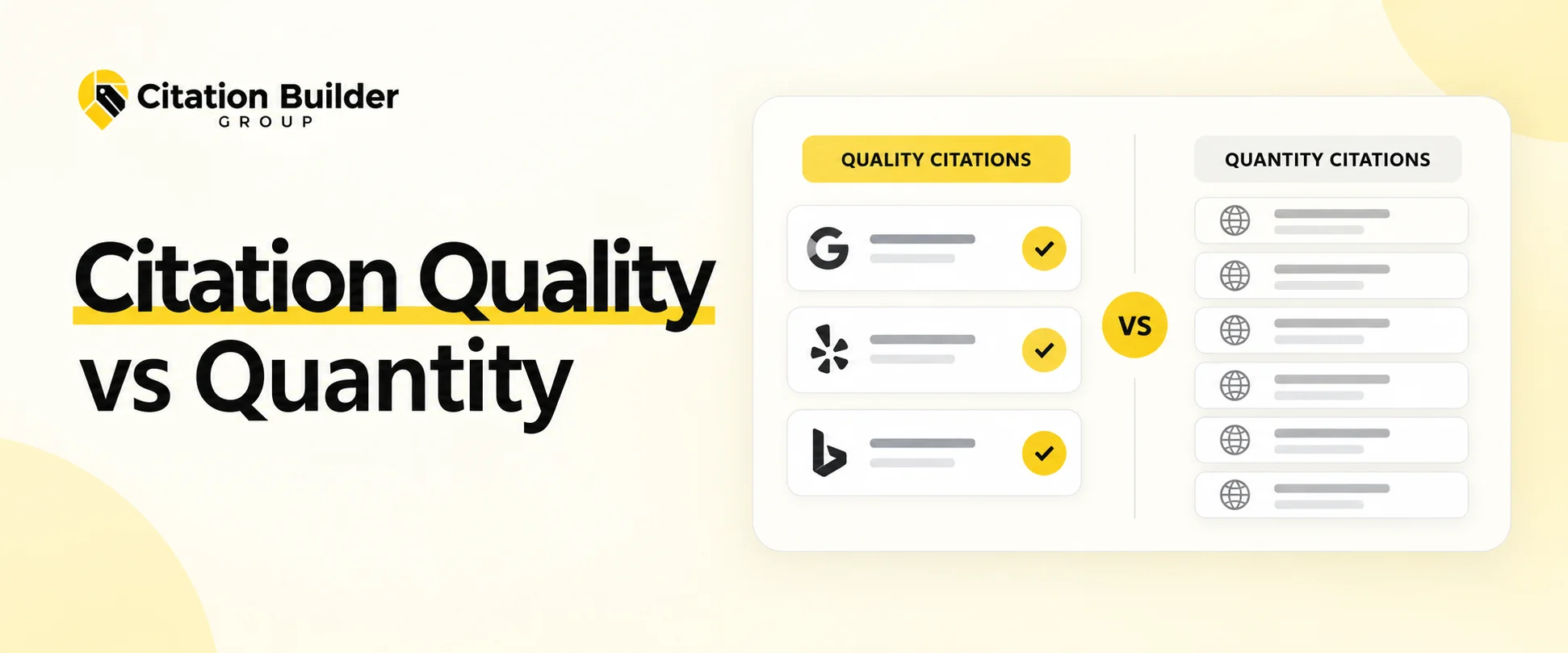
Citation Quality vs Quantity Comparison
| Factor | Quality-first citation building | Quantity-first citation building |
|---|---|---|
| Directory selection | Based on location, industry, credibility, and usefulness | Based mainly on the number of available submission sites |
| NAP information | Verified and standardized before submission | May be copied from incomplete or outdated sources |
| Profile content | Complete categories, descriptions, hours, images, and links | Frequently limited to basic information |
| Existing listings | Checked before creating a new profile | May create duplicate listings |
| Customer value | Prioritizes websites that help users discover the business | May include directories with little or no relevant audience |
| Reporting | Tracks submission, status, URL, and login information where applicable | Often provides limited visibility into individual listings |
| Maintenance | Focuses attention on profiles worth maintaining | Creates a larger and more complicated update workload |
| Long-term value | Builds a controlled and relevant citation footprint | May produce many low-value or abandoned profiles |
This comparison does not mean every campaign should use the smallest possible number of websites. It means each submission should pass a reasonable quality test.
How to Build a Quality-First Local Citation Strategy
A sustainable local citation strategy starts with planning, not submission volume.
1. Create an approved business data record
Prepare a master document containing the exact business name, address, local phone number, website URL, categories, opening hours, description, social profiles, and service areas.
This record should be reviewed before citation work begins. If the company has multiple locations, create a separate approved record for every branch.
2. Audit existing citations
Search for existing profiles, outdated details, duplicates, and inconsistent variations. An audit prevents unnecessary submissions and identifies corrections that may be more important than building new listings.
3. Cover core platforms
Begin with established platforms relevant to the country and business type. These may include search, mapping, review, and major business directory services.
4. Add country and local directories
The next stage should focus on national, regional, and city-level platforms. These sources improve geographic relevance and may connect the company with local customers.
5. Identify industry opportunities
Research directories, associations, and professional portals connected to the company’s sector. These platforms can strengthen topical relevance and diversify the citation profile.
6. Complete each profile carefully
Use the approved business record, select the most accurate categories, write clear descriptions, and fill in all useful fields. Directory listing quality should be reviewed before considering the submission complete.
For a complete implementation process, use this guide on how to build local citations.
7. Record every submission
Maintain a report that includes the directory name, submitted business information, profile URL, submission date, status, and any verification requirements.
8. Review listings periodically
Businesses change over time. Phone numbers, addresses, opening hours, services, and websites may be updated. Important citations should be checked periodically so they continue to reflect the company accurately.
A structured local citation building checklist can help teams apply the same quality standards across every campaign.
Manual vs Automated Citation Building
The method used to create listings can directly influence the citation quality vs quantity balance.
Automated distribution can provide speed and broad coverage, but available fields and supported platforms may be limited. It may also be difficult to adapt every submission to the exact requirements of local or specialist directories.
Manual citation building allows each website to be reviewed individually. Existing profiles can be checked, relevant categories can be selected, descriptions can be adjusted, and optional fields can be completed where available.
Neither speed nor manual work should be treated as the only objective. The right method depends on the business, target locations, existing citation profile, and required level of control.
Our detailed manual vs automated citation building comparison explains the advantages and limitations of both approaches.
Citation Building Across Different Countries
Directory selection should be localized. A citation source that is useful in one country may have limited relevance in another. Businesses should not simply repeat the same directory list across every target market.
Citation Builder Group provides citation services for businesses targeting:
- United States
- United Kingdom
- Canada
- Australia
- South Africa
- Netherlands
- Germany
- Singapore
- New Zealand
- France
- Spain
- Italy
- Turkey
- Greece
- Sweden
- Switzerland
- Austria
- Belgium
- Portugal
A localized campaign should prioritize high quality citation sites that serve the selected country, region, or industry. It should also account for local address formats, languages, phone number formats, business categories, and directory requirements.
For example, a business targeting both Germany and France may require separate directory research for each country. A single international platform cannot replace credible national and local sources in both markets.
This is another reason citation quality vs quantity must be assessed within the correct geographic context. Fifty relevant listings distributed across appropriate target markets may provide a stronger foundation than hundreds of submissions to directories with no meaningful local audience.
Common Mistakes in Citation Quality vs Quantity Planning
Businesses should avoid several common errors when developing their citation profiles.
Selecting directories based only on authority metrics
Authority scores can support research, but they do not measure every type of value. Geographic relevance, industry relevance, customer use, and directory moderation should also be examined.
Ignoring low-authority niche directories
A legitimate professional association or local directory may have a smaller website while still reaching an appropriate audience. Citation relevance and authority should be evaluated together.
Using an identical directory list for every business
A plumber, lawyer, restaurant, medical clinic, and software company do not have exactly the same citation opportunities. Directory selection should reflect the business category and target market.
Building new listings before correcting existing ones
Creating additional profiles does not solve inaccurate information. Existing high-priority listings should be corrected or consolidated where possible.
Treating every citation as a backlink
The value of a citation is not limited to link attributes. Business information, platform trust, customer discovery, and local relevance can all matter.
Stopping after submission
Some directories require email, phone, postcard, or document verification. A submitted profile may not become publicly visible until those steps are completed.
How Citation Builder Group Supports Quality-Focused Campaigns
A successful campaign requires more than collecting a large list of submission websites. It requires accurate business data, careful directory research, appropriate categorization, duplicate checks, detailed profiles, and transparent reporting.
Citation Builder Group helps businesses build citations through a structured process designed around relevance and accuracy. Instead of viewing every available directory as equally valuable, the campaign can focus on suitable platforms for the business’s country, location, and industry.
Our citation building services can support businesses that need a new citation foundation, want to improve existing coverage, or plan to expand into additional markets.
The final decision in the citation quality vs quantity debate is not that quantity should be ignored. It is that quantity should be controlled by quality. Every listing should contribute to a more accurate, relevant, and useful online presence.
Frequently Asked Questions About Citation Quality vs Quantity
What does citation quality vs quantity mean?
Citation quality vs quantity compares the value of accurate listings on relevant, trusted directories with the total number of citations a business has. A strong campaign prioritizes useful directories and consistent business information before expanding the number of listings.
Is citation quality more important than quantity?
Quality should generally come first. Accurate citations on geographically relevant, industry-relevant, and established websites are usually more useful than numerous incomplete listings on unrelated directories. However, businesses still need sufficient coverage across appropriate platforms.
How many citations does a local business need?
There is no universal number that applies to every business. The required coverage depends on the country, city, industry, number of locations, existing listings, and competitive environment. The objective should be to cover relevant opportunities rather than reach an arbitrary total.
What are high quality citation sites?
High quality citation sites are legitimate platforms that serve real users, maintain structured business profiles, provide suitable categories, and have geographic or industry relevance. They should also allow businesses to present accurate and useful information.
How can I measure citation relevance and authority?
Review the directory’s audience, geographic coverage, industry categories, profile quality, search visibility, moderation, and overall credibility. Authority metrics may assist with evaluation, but they should not replace a manual assessment of relevance and usefulness.
What determines directory listing quality?
Directory listing quality depends on both the platform and the completed profile. Important factors include correct NAP information, suitable categories, a useful description, accurate hours, relevant images, the correct website URL, and the absence of duplicate profiles.
Can low-quality citations harm a local citation strategy?
Low-quality listings may create inconsistent information, duplicates, unnecessary maintenance, and a confusing customer experience. Instead of building as many citations as possible, businesses should select directories carefully and monitor important profiles.
Should every business use the same citation sites?
No. Core platforms may overlap, but local citation strategy should be adapted to the business’s location, industry, services, and audience. Country-specific, city-specific, and niche directories will vary from one business to another.
Are industry directories better than general directories?
Both types can be useful. Established general directories can provide broad visibility, while relevant industry directories can offer greater topical alignment. A balanced campaign often includes both.
How often should citations be reviewed?
Important citations should be reviewed whenever business information changes and checked periodically for accuracy. Multi-location businesses and companies with frequent operational changes may require more regular monitoring.
Can Citation Builder Group create international citations?
Yes. Citation Builder Group provides services across multiple markets, including the United States, United Kingdom, Canada, Australia, South Africa, several European countries, Singapore, and New Zealand. Directory selection is adapted to the target country rather than relying on one generic list.
What is the best approach to citation quality vs quantity?
Begin with accurate business data, audit existing listings, cover established platforms, add relevant national and local directories, and then build suitable industry citations. This approach increases coverage while protecting accuracy, relevance, and long-term directory listing quality.