

Choosing between manual vs automated citation building is an important decision for businesses, agencies, and local SEO professionals trying to improve visibility in local search results. Both methods can distribute business information across online directories, mapping platforms, local portals, and industry-specific websites, but they differ significantly in accuracy, control, coverage, speed, and long-term value.
Manual citation submissions involve finding relevant directories and creating or updating each business listing individually. Automated listing distribution uses software or connected data networks to send business information to multiple platforms at once.
Automated distribution can be fast and scalable, while manual submission allows greater control over every listing. The right option depends on the business location, number of locations, existing citation problems, budget, target directories, and local SEO objectives.
Before choosing a method, it is useful to understand what local citations are and how they help search engines verify essential business information.
What Is Citation Building?
Citation building is the process of creating business listings and mentions across online platforms. These platforms can include:
- Business directories
- Mapping services
- Local search platforms
- Social media profiles
- Industry-specific websites
- Chamber of commerce websites
- Review platforms
- Government or professional directories
- Local news and community websites
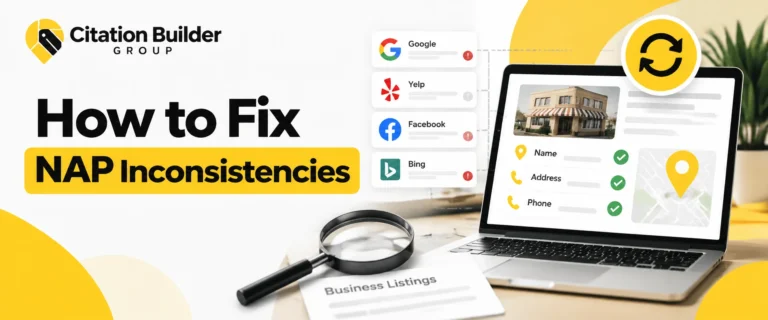
A standard citation usually includes a business name, address, and phone number. These three details are commonly called NAP information. A complete business listing may also include:
- Website URL
- Business category
- Opening hours
- Business description
- Email address
- Service areas
- Images
- Social media links
- Payment methods
- Products and services
- Appointment or booking links
Citation quality is not determined only by the number of listings created. Accuracy, relevance, platform authority, geographic suitability, completeness, and consistency all affect the value of a citation campaign.
To understand why uniform business data matters, read what NAP consistency means for local search performance.
Understanding Manual vs Automated Citation Building
The main difference in manual vs automated citation building is how listings are created and managed.
With manual citation submissions, a person visits each directory, evaluates its relevance, creates an account when necessary, completes the listing, verifies the information, and records the final URL or submission status.
With automated listing distribution, business data is entered into a software platform or distribution service. The system then sends the information to connected publishers, directories, applications, and data partners.
Both processes aim to increase the visibility and consistency of business information, but they offer different advantages and limitations.
Automated systems prioritize distribution speed and scale. Manual citation building prioritizes individual platform selection, accuracy, customization, and direct listing control.
What Are Manual Citation Submissions?
Manual citation submissions are listings created one directory at a time without relying entirely on bulk distribution software.
A trained citation builder reviews the business details, finds appropriate platforms, completes the registration forms, selects categories, writes descriptions, uploads images, and handles verification when possible.
A typical manual workflow includes:
- Auditing existing business citations
- Preparing accurate business information
- Researching directories for the target country
- Selecting industry-relevant platforms
- Checking whether a listing already exists
- Creating or claiming the listing
- Completing available business fields
- Submitting verification information
- Recording the listing URL and status
- Monitoring pending or rejected submissions
Manual citation submissions can be especially valuable when directories have different fields, category systems, verification procedures, or regional requirements.
Businesses can use this local citation building checklist to prepare the information needed before starting a campaign.
Advantages of Manual Citation Building
Greater Control Over Directory Selection
Manual submission allows the citation builder to choose directories based on relevance, authority, location, industry, and submission quality.
A local contractor in Canada may need different directories from a hotel in Italy or a legal practice in the United Kingdom. Manual research makes it possible to build a list specifically for the business rather than submitting to the same network for every campaign.
Better Listing Customization
Each directory may offer different fields. One platform might accept a long description, while another may allow services, social links, images, opening hours, or service-area information.
Manual citation submissions allow these fields to be completed individually instead of distributing one limited data set everywhere.
More Accurate Category Selection
Business categories vary between directories. Automated systems may map a general category across multiple platforms, but the closest available category is not always the most accurate one.
A human citation builder can review the available options and select the most appropriate category on each platform.
Access to Niche and Local Directories
Many valuable directories are not connected to automated distribution networks. These can include regional portals, professional associations, local chambers, trade directories, tourism platforms, and industry-specific websites.
Manual citation building helps businesses reach platforms that automation may miss.
Better Duplicate Detection
A business may already have incomplete, outdated, or duplicate listings. Creating another automated listing without checking the directory can increase inconsistency.
A manual approach makes it possible to search for existing records before submitting a new listing.
Greater Ownership and Transparency
Manual citation services can provide direct URLs, usernames, status reports, and submission notes. When account access is available, the business may retain greater control over future updates.
Limitations of Manual Citation Building
Manual citation building also has disadvantages.
It Takes More Time
Finding directories, completing forms, selecting categories, and tracking submissions requires considerable time. This becomes more challenging for businesses with many locations.
Verification Can Delay Publication
Some directories require email, phone, postcard, or document verification. A manual submission may remain pending until the business completes the required step.
Results Are Not Instant
Citation building should not be treated as an immediate ranking solution. Directories may take days or weeks to review submissions, and search engines need time to discover and process published listings.
Quality Depends on the Provider
Poor manual work can create the same problems associated with low-quality automation. Incorrect fields, weak descriptions, irrelevant directories, and duplicate records reduce the effectiveness of the campaign.
Citation Builder Group offers professional local citation building services for businesses that need structured submissions and geographically relevant directory research.
What Is Automated Listing Distribution?
Automated listing distribution uses software to send business information to a network of connected platforms. The company enters its details once, and the system distributes or synchronizes those details across participating publishers.
Business listing automation can be useful for:
- Multi-location businesses
- Brands needing rapid data distribution
- Companies with frequent opening-hour changes
- Businesses that require centralized listing management
- Agencies managing large numbers of locations
- Enterprises that need regular data synchronization
Some automated services provide a dashboard where users can update business information. Changes may then be distributed to supported platforms.
The specific capabilities depend on the provider, country, publisher network, and type of subscription.
Advantages of Automated Citation Building
Faster Distribution
Automated listing distribution can send business information to many connected platforms in a relatively short time.
For businesses with multiple branches, entering the same data manually across every supported directory can require significant resources. Automation reduces repeated data entry.
Easier Multi-Location Management
Businesses with tens or hundreds of locations may need a central system for managing names, addresses, phone numbers, hours, and temporary closures.
Business listing automation can make large-scale data management more practical.
Centralized Updates
Some systems allow users to update business information from one dashboard. This can be helpful when a company changes its phone number, opening hours, website, or service information.
Monitoring Capabilities
Depending on the platform, automated services may include listing-status monitoring, duplicate alerts, accuracy reports, review monitoring, or analytics.
Consistent Basic Information
When the source data is correct, automation can distribute the same core business details across its publisher network, reducing manual retyping errors.
Limitations of Automated Citation Building
Limited Directory Coverage
Automated systems only reach platforms connected to their distribution network. They may not include important local, industry-specific, or country-specific directories.
Less Customization
Automated distribution usually depends on standardized fields. It may not provide the same level of description, category, image, service, or profile customization available through manual submissions.
Subscription Dependence
Some automated listing services operate on a recurring subscription model. The status of distributed data after cancellation can vary by provider and publisher.
Before selecting a service, businesses should understand what happens to their listings when the subscription ends.
Possible Category Mapping Issues
A category selected in the central dashboard may not translate perfectly across every directory. This can result in overly broad or inaccurate categories.
Existing Listings May Cause Conflicts
If the business already has listings created under different names or addresses, automated distribution may not resolve every duplicate. In some cases, it can create additional records or conflict with previously claimed profiles.
Geographic Availability Varies
A network with strong coverage in the United States may have limited reach in Greece, Turkey, Portugal, South Africa, or Singapore. Coverage should be assessed separately for each target country.
Manual vs Automated Citation Building Comparison
The following citation service comparison highlights the main differences between the two methods:
| Factor | Manual Citation Building | Automated Citation Building |
|---|---|---|
| Submission process | One directory at a time | Distributed through software |
| Speed | Slower | Faster |
| Directory selection | Highly customizable | Limited to connected network |
| Niche directories | Strong coverage potential | Often limited |
| Local directory research | Available | Depends on platform |
| Category selection | Selected individually | Often mapped automatically |
| Listing customization | High | Usually standardized |
| Multi-location scalability | More resource-intensive | Strong |
| Ongoing subscription | Usually not required | Often required |
| Duplicate checking | Can be performed individually | Varies by system |
| Listing ownership | Often more direct | Depends on provider |
| Reporting | Submission-specific | Dashboard-based |
| International flexibility | Can be researched by country | Depends on publisher network |
This comparison shows why manual vs automated citation building should not be reduced to a simple question of which method is universally better. The best method depends on the campaign.
Which Method Produces Better Citation Quality?
Quality depends on execution, not only on whether the campaign is manual or automated.
A manually created listing on an irrelevant, low-quality directory may offer little value. An automated listing on a recognized mapping or data platform may be useful.
Likewise, automated distribution may create fast coverage but still miss authoritative local directories that require individual submissions.
High-quality citation building considers:
- Directory relevance
- Geographic relevance
- Industry relevance
- Listing accuracy
- Profile completeness
- NAP consistency
- Category accuracy
- Duplicate control
- Listing permanence
- Verification status
- Business ownership
- Reporting transparency
Review these local citation examples to understand the different platforms and formats that may appear in a citation campaign.
Manual vs Automated Citation Building for NAP Consistency
NAP consistency means maintaining accurate and recognizable business name, address, and phone information across the web.
Both manual and automated methods can support consistency, but both can also cause problems when the source data is incorrect.
With manual citation submissions, every listing can be reviewed before publication. This makes it possible to adapt formatting while preserving the same underlying information.
With automated listing distribution, the system distributes one central data set. This is efficient, but an error in the original data can be pushed to many platforms.
Before using either method, businesses should prepare a master NAP document containing:
- Official business name
- Trading name where applicable
- Full address
- Address formatting
- Primary phone number
- Local phone number
- Website URL
- Opening hours
- Primary category
- Secondary categories
- Business description
- Service areas
- Social links
- Email address
This master information should be approved before any submissions begin.
Are Manual Citations Better for Local SEO?
Manual citations can be more suitable when the goal is to build a targeted portfolio of relevant listings.
This approach is particularly useful for:
- Single-location businesses
- Service-area businesses
- Companies entering a new country
- Businesses in specialized industries
- Campaigns requiring niche directories
- Companies with duplicate-listing problems
- Businesses that want individual submission reports
- Locations with limited automated coverage
Manual work allows the campaign to prioritize directories that matter for a specific industry and location.
For a practical explanation of the workflow, see how to build local citations correctly.
Is Automation Better for Multi-Location Businesses?
Automation may be more practical for organizations with a large number of locations and frequent data changes.
A multi-location company may need to update holiday hours, phone numbers, branch URLs, or operating information across a large network. Managing every update manually can become inefficient.
Business listing automation can provide:
- Central data management
- Faster updates
- Scalable location management
- Standardized core information
- Monitoring through one dashboard
However, automation does not remove the need for manual oversight. Local landing pages, country-specific directories, niche platforms, duplicate cleanup, and category verification may still require human review.
When a Hybrid Strategy Works Best
For many businesses, the best answer to manual vs automated citation building is a hybrid strategy.
A hybrid campaign combines automated distribution for major supported platforms with manual citation submissions for directories that require human work.
The automated part can support scale and centralized updates. The manual part can cover:
- Local directories
- Niche platforms
- Professional associations
- Industry portals
- Country-specific websites
- Directories outside the automated network
- Platforms requiring custom verification
- Listings needing duplicate correction
- Opportunities requiring detailed profile completion
A hybrid approach can provide greater coverage without relying entirely on one method.
Citation Builder Group helps businesses evaluate directory needs through its citation building and local listing services.
Citation Building in Different Countries
Citation availability varies significantly by country. A directory that is important in one market may have little relevance in another.
Citation Builder Group provides citation building services across multiple international markets, including:
- United States
- United Kingdom
- Canada
- Australia
- South Africa
- Netherlands
- Germany
- Singapore
- New Zealand
- France
- Spain
- Italy
- Turkey
- Greece
- Sweden
- Switzerland
- Austria
- Belgium
- Portugal
An international citation campaign should not simply copy a United States directory list for every country. Each market has different business directories, mapping platforms, languages, address formats, phone-number structures, and verification practices.
English-Speaking Markets
The United States, United Kingdom, Canada, Australia, New Zealand, South Africa, and Singapore have many English-language listing opportunities. However, each market still requires a country-specific directory strategy.
A business targeting several of these countries should create separate directory lists and business data documents for each location.
European Markets
Germany, France, Spain, Italy, Netherlands, Belgium, Austria, Switzerland, Portugal, Greece, Sweden, and Turkey require careful local research.
Local language, regional domains, address standards, category terminology, and national platforms can affect submission quality. Manual citation building may provide greater flexibility in these markets because it allows the provider to select country-specific directories individually.
Multilingual Listings
Businesses operating in multilingual markets should determine:
- Which language the directory uses
- Whether multiple languages are supported
- Which language customers use for local searches
- Whether business names should remain unchanged
- How categories should be translated
- Whether descriptions can be localized
- Whether city and address formats follow local conventions
Localization should improve clarity without changing the official identity of the business.
Visit Citation Builder Group to learn more about citation campaigns for different countries and business categories.
Manual vs Automated Citation Building and Listing Ownership
Listing ownership is an important factor that is sometimes overlooked during a citation service comparison.
With manual submissions, a listing may be created through a dedicated business account. When login details can be transferred, the business may be able to update the listing directly in the future.
With automated listing distribution, the business may manage the listing through the provider’s dashboard. Direct ownership or access can differ between publishers.
Before ordering a service, ask:
- Will the business receive listing URLs?
- Are usernames or account details provided?
- Can listings be edited later?
- What happens if the service is cancelled?
- Will the data remain on publisher websites?
- Can existing listings be claimed?
- Are verification steps included?
- How are duplicate listings handled?
Clear answers make it easier to compare the long-term value of different services.
Manual vs Automated Citation Building and Backlinks
Citations and backlinks are related but different local SEO signals.
A citation mentions business information, while a backlink provides a clickable link from another website. Some citations contain a website link, but the primary purpose of citation building is to improve business-data visibility and consistency.
Citation campaigns should not be evaluated only by link metrics. A valuable directory may provide an accurate business listing even if its links are nofollow or redirected.
Read local citations vs backlinks for a complete comparison of their purposes in local SEO.
Structured and Unstructured Citation Opportunities
Structured citations display business information in organized fields, such as name, address, phone number, categories, and hours.
Unstructured citations mention the business naturally within an article, sponsorship page, press release, event page, or local organization website.
Manual vs automated citation building usually focuses primarily on structured citations because automated systems need standardized data fields. Unstructured citations are more likely to require outreach, public relations, local partnerships, content creation, or sponsorship.
Learn more about structured vs unstructured citations and how both formats can contribute to a broader local visibility strategy.
Do Citations Still Help Local SEO?
Citations can still support local SEO by helping search engines and users find consistent business information across relevant platforms.
Their effectiveness depends on quality rather than volume alone. Creating hundreds of listings on irrelevant or low-quality websites is unlikely to outperform a smaller set of accurate, relevant, and authoritative profiles.
Citations can help with:
- Business discovery
- NAP consistency
- Brand visibility
- Referral traffic
- Local trust signals
- Directory visibility
- Customer access to contact information
- Supporting a complete local search presence
They should be combined with an optimized Google Business Profile, local landing pages, reviews, localized content, technical SEO, and relevant backlinks.
Explore whether local citations help SEO to understand their role within a complete local search campaign.
How to Choose Between Manual and Automated Citation Services
When comparing manual vs automated citation building, consider the following questions:
- How many business locations need citations?
- Which countries are being targeted?
- Does the business need local or industry directories?
- Are duplicate listings already present?
- How often does the business information change?
- Is centralized management necessary?
- Does the business need direct listing URLs?
- Is an ongoing subscription acceptable?
- Are detailed descriptions and categories important?
- Will the provider support verification?
- What happens to listings after cancellation?
- Does the service include country-specific research?
A citation service comparison should examine the actual process, platform coverage, reporting, ownership, and support rather than focusing only on the number of promised listings.
Common Citation Building Mistakes
Prioritizing Quantity Over Relevance
A large number of low-quality citations is not necessarily more valuable than a smaller number of relevant listings.
Using Inconsistent Business Information
Different business names, old phone numbers, incorrect addresses, and multiple website versions can weaken citation consistency.
Creating Duplicate Listings
Submitting without checking for an existing profile can create duplicates that confuse customers and search engines.
Selecting Incorrect Categories
Broad or unrelated categories reduce listing relevance and may attract the wrong audience.
Ignoring Country-Specific Directories
An international campaign needs separate directory research for each target market.
Failing to Track Submissions
Every campaign should record the directory, listing URL, submission date, status, and verification requirements.
Depending Entirely on Automation
Automated platforms may not reach important niche or local directories.
Ignoring Automated Distribution
For large multi-location businesses, an entirely manual system may make regular updates difficult to manage.
Frequently Asked Questions About Manual vs Automated Citation Building
What is the difference between manual and automated citation building?
Manual citation building involves submitting business details to each directory individually. Automated citation building uses software to distribute business information to a connected network of publishers.
Is manual citation building better for local SEO?
Manual citation building can provide better directory selection, customization, local research, category control, and access to niche platforms. Its value depends on the quality and accuracy of the submissions.
Is automated listing distribution faster?
Yes. Automated listing distribution can send business data to multiple supported platforms faster than individual submissions. However, it only reaches directories included in the provider’s network.
Can automation create duplicate business listings?
It can happen when existing listings are not identified or matched correctly. Businesses should audit current citations and understand how the service handles duplicate records before distribution.
Do automated citations disappear after cancellation?
This depends on the provider and publisher. Some listings may remain, while others may lose synchronization, revert, or become harder to manage. The cancellation policy should be reviewed in advance.
Are manual citation submissions permanent?
No provider can guarantee that every directory will keep a listing permanently. Directories can change policies, remove profiles, close, or request reverification. Manual listings are often created individually, but their continued publication depends on the directory.
Which method is better for multiple locations?
Automated listing distribution is often more scalable for businesses with many locations. A hybrid approach can add manual submissions for local, niche, and country-specific directories.
Can manual and automated citation building be used together?
Yes. A hybrid approach uses automation for supported platforms and manual submissions for valuable directories outside the distribution network.
How many citations does a business need?
There is no universal number. The business should prioritize leading platforms, trusted national directories, relevant local sites, and appropriate industry-specific directories.
Which countries does Citation Builder Group support?
Citation Builder Group provides services in the United States, United Kingdom, Canada, Australia, South Africa, Netherlands, Germany, Singapore, New Zealand, France, Spain, Italy, Turkey, Greece, Sweden, Switzerland, Austria, Belgium, and Portugal.
Choose the Right Citation Building Strategy
The choice between manual vs automated citation building depends on the size of the business, number of locations, target countries, existing listings, need for customization, and long-term management requirements.
Manual citation submissions provide greater individual control, access to niche platforms, country-specific research, and detailed customization. Automated listing distribution provides speed, centralized management, and scalability.
For many companies, a hybrid strategy delivers the most balanced solution. It can combine the reach of business listing automation with the accuracy and relevance of manual directory research.
Citation Builder Group supports businesses and agencies with targeted citation campaigns across multiple countries. Explore its professional citation building services to select a campaign suited to your locations and local SEO objectives.