
Business owners and SEO professionals ask one question more than almost any other: how many citations do you need to rank well in local search results? The answer is not a single magic number, but understanding the benchmarks, industry variations, and quality factors behind citation counts will help you build a strategy that delivers results. This guide examines the data, explains the factors that influence the ideal citation count, and shows you how to benchmark against competitors in your market.
For businesses looking for professional support, Citation Builder Group provides manual citation building services across major markets worldwide.
Understanding How Many Citations Do You Need: The Benchmark Landscape
What the Data Tells Us About Citation Counts
Research into local search rankings provides useful benchmarks for answering how many citations do you need. A comprehensive study of over 122,000 local businesses across 26 industries found that businesses ranking in the top 10 Google Local positions have an average of 81 citations. The data revealed a clear correlation between citation volume and ranking position: businesses ranked number one averaged 86 citations, while those in position ten averaged 75.
This pattern holds across industries, though the absolute numbers vary significantly. The study showed that businesses appearing in the top three positions consistently had more citations than those ranking lower, suggesting that citation volume contributes to local search prominence.
To understand the fundamental building blocks of this strategy, it helps to first review what are local citations and how they function as identity signals for search engines.
Industry Variations in Ideal Citation Count
The question of how many citations do you need cannot be answered without considering your specific industry. Hospitality businesses—hotels, bars, and restaurants—tend to have the highest citation counts, often exceeding 100 listings. Medical practices and dental offices also show elevated citation profiles, with dentists averaging 107 citations and medical practices averaging 101.
At the other end of the spectrum, photographers average just 34 citations, while tradesmen, storage businesses, and cleaning services also tend to have lower citation counts. These variations reflect differences in how customers search for and discover different types of businesses, as well as the availability of industry-specific directories.
Understanding the difference between structured vs unstructured citations helps explain why some industries naturally accumulate more listings than others.
Factors That Determine How Many Citations Do You Need
Market Competitiveness and Citation Benchmarks
The number of citations your business needs depends heavily on the competitiveness of your local market. In low-competition markets, 40 to 50 high-quality citations on the best business directories may be sufficient to establish visibility. However, in competitive metropolitan areas, businesses appearing in the Map Pack often have 100 to 200 or more citations.
This means that the answer to how many citations do you need is inherently relative. Rather than targeting an absolute number, you should analyze the citation profiles of your direct competitors. If your top-ranking competitors have 120 citations and you have 40, closing that gap should be a priority. If they have 50 and you have 45, your focus should shift to citation quality and consistency.
The Role of Citation Benchmark Competitors
Understanding your competitive landscape requires more than simply counting citations. You need to assess citation benchmark competitors to identify where your business stands relative to others in your market. This involves examining not just how many citations competitors have, but which directories they appear on, how complete their listings are, and whether their NAP data is consistent across platforms.
A citation share benchmark approach can help quantify your competitive position. This metric compares your citation presence against the total citation presence of all competitors in your category, providing a clear picture of whether you are leading, matching, or trailing the market. If your competitors collectively dominate citation sources that you have not yet claimed, that represents an immediate opportunity for improvement.
Business Age and Citation Growth
Newer businesses typically need to build more foundational citations than established brands. An established business may already have accumulated citations organically through years of operation, while a new business starts from zero. This means that how many citations do you need is partly a function of where you are in your business lifecycle.
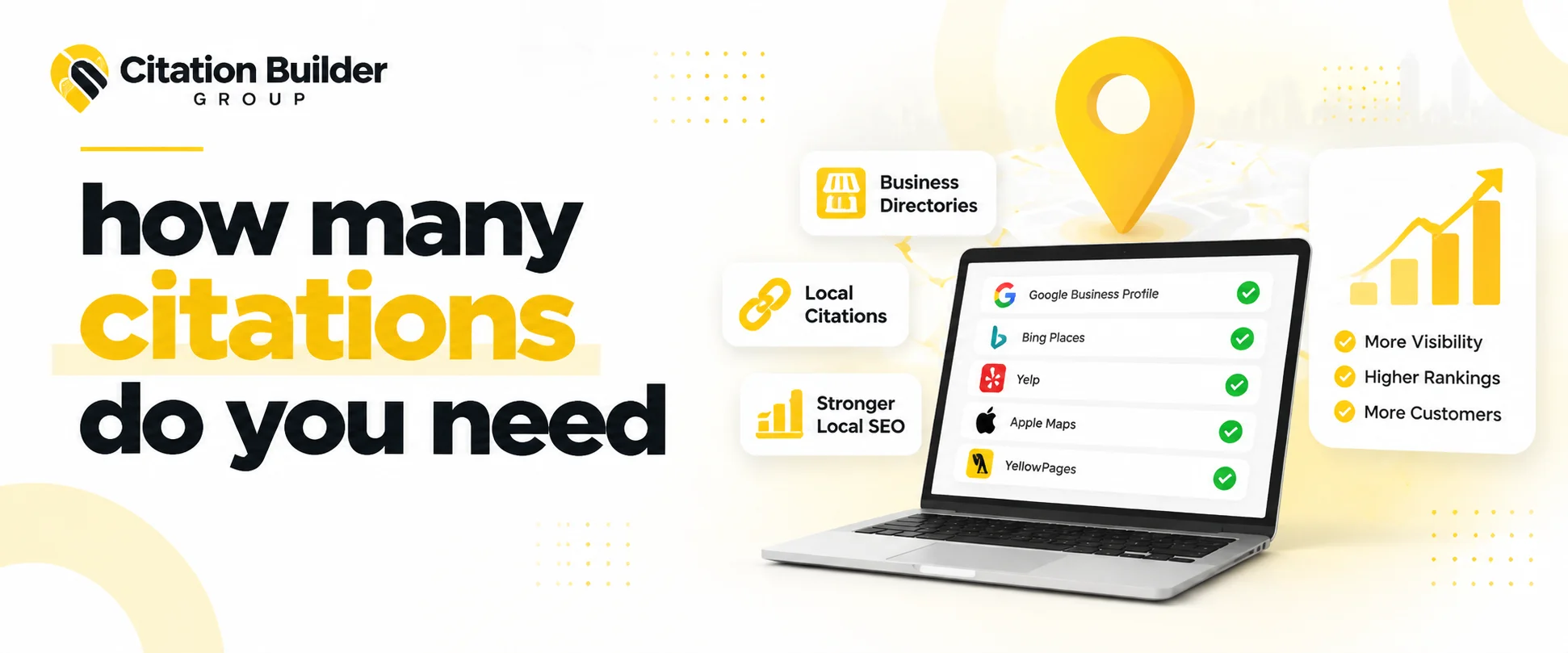
For new businesses, the priority should be establishing presence on the essential platforms: Google Business Profile, Bing Places, Apple Maps, Facebook, and the major industry-specific directories for your category. Once those foundational citations are secured and consistent, you can expand to additional sources.
Quality Versus Quantity in Citation Building
Why Consistent Citations Matter More Than Raw Numbers
The single most important factor in citation building is not quantity but consistency. NAP consistency—ensuring your Name, Address, and Phone number appear identically across every citation—matters more than having hundreds of listings. When search engines encounter conflicting business information, trust signals weaken, and rankings can suffer.
This principle directly affects how many citations do you need. Fifty perfectly consistent citations will outperform 200 inconsistent ones. Before pursuing additional citations, audit your existing listings for errors, outdated information, and duplicate profiles. Correcting those issues will have a greater impact than adding new citations on top of a flawed foundation.
The Risk of Low-Quality Citations
Submitting your business to dozens or hundreds of low-quality directories creates more problems than it solves. These listings can become outdated, create duplicates, and waste resources that could be better spent on high-authority sources. Search engines care more about accurate, relevant signals than random listings on sites with no real traffic or trust.
When determining how many citations do you need, focus on directories that are relevant to your industry, your location, or both. A listing on a respected local chamber of commerce website or a niche industry directory may be far more valuable than ten generic directory submissions with no audience.
To see what effective citations actually look like across different platforms, review these local citation examples for practical reference.
How to Benchmark Your Citation Count Against Competitors
Conducting a Citation Benchmark Analysis
To determine your target citation count, start by analyzing your top competitors in local search results. Identify the businesses that consistently appear in the Map Pack for your target keywords, then research their citation profiles using tools like Moz Local, BrightLocal, or Whitespark.
Create a spreadsheet that tracks the following for each competitor:
-
Total number of citations discovered
-
Presence on major platforms (Google, Yelp, Facebook, Bing Places)
-
Presence on industry-specific directories
-
NAP consistency across listings
-
Completeness of profile information
This analysis will reveal whether you are ahead, behind, or on par with the competitive set. If your competitors have significantly more citations, closing that gap should be a priority. If you are already competitive in citation volume, shift your focus to consistency and profile optimization.
Setting Realistic Citation Targets
Based on your competitive analysis and industry benchmarks, set a realistic citation target. For most local businesses, the following framework provides a reasonable starting point:
Foundational citations (20-40 listings): Google Business Profile, Bing Places, Apple Maps, Facebook, Yelp, Yellow Pages, and the top five to ten directories in your industry. These are non-negotiable for any local business.
Competitive citations (40-80 listings): Additional industry-specific directories, local chamber listings, and respected regional platforms. This range typically aligns with the average for top-ranking businesses across most industries.
Comprehensive citations (80-150+ listings): Expanded coverage on niche directories, data aggregators, and local/regional sources. This level is appropriate for businesses in highly competitive markets or industries with high citation averages.
Rather than treating these ranges as rigid rules, use them as guides while monitoring your competitive position and ranking results. For a deeper look at whether these efforts translate into rankings, read do local citations help SEO.
How Many Citations Do You Need: Building Citations the Right Way
Manual Submission and Quality Control
Learning how to build local citations properly involves more than bulk submission. Manual submission allows you to detect existing listings, select the correct categories, and ensure each profile is complete and accurate. This approach is slower than automated tools, but it produces higher-quality results.
For each directory, verify whether a listing already exists before creating a new one. Claim existing profiles where possible, and correct any inaccurate information. Create new listings only when no existing profile is found.
The Role of Structured vs. Unstructured Citations
Citations come in two main forms. Structured citations place business information into predefined directory fields, while unstructured citations mention the business naturally within articles, news stories, or community pages. Understanding the difference helps you build a balanced profile.
Most businesses focus on structured citations first because they are easier to control and standardize. However, unstructured citations can add significant value by associating your business with local events, news coverage, or community involvement. Pursuing both types creates a more natural and authoritative online footprint.
NAP Consistency and Citation Maintenance
Auditing Your Existing Citations
Even if you have built citations in the past, they may no longer be accurate. Businesses move, change phone numbers, and rebrand. An audit of your existing citations should be the first step in any citation strategy.
Search for your business name, old names, current and former phone numbers, and current and former addresses. Compile a list of every listing you find, noting whether the information is accurate, incomplete, or incorrect. Prioritize fixes on high-authority directories first, since these have the greatest impact on search visibility.
Ongoing Citation Management
Citation building is not a one-time task. Business information changes, directories merge or close, and new platforms emerge. Periodically reviewing your citations ensures that your business information remains accurate and that duplicate listings are addressed before they cause problems.
For businesses with multiple locations, citation management becomes more complex. Each location needs its own distinct NAP record, and cross-contamination between locations can confuse both customers and search engines. A centralized listing management system can help maintain consistency across all locations.
International Citation Building Considerations
Country-Specific Directory Ecosystems
The directories that matter most vary significantly by country. A platform that is essential in the United States may have little relevance in Germany or Singapore. When building citations internationally, research the directories that are actually used by consumers in each market.
Countries served by Citation Building Group include:
United States, United Kingdom, Canada, Australia, South Africa, Netherlands, Germany, Singapore, New Zealand, Ireland, France, Spain, Italy, Turkey, Greece, Sweden, Switzerland, Austria, Belgium, Portugal.
For each country, directory selection should reflect local search behavior. Address formats, phone number conventions, and language requirements also vary, so citations should be localized appropriately. You can explore the full range of citation services to see how these are delivered across markets.
Frequently Asked Questions About How Many Citations Do You Need
How many citations do you need to rank in local search?
There is no universal number. Research shows that top-ranking businesses average around 81 citations, but this varies by industry and market competitiveness. Businesses in low-competition markets may rank with 40-50 citations, while those in competitive metros often need 100-200 or more. The most reliable approach is to benchmark against your direct competitors and aim to match or exceed their citation presence.
Does the number of citations matter more than quality?
Quality and consistency matter more than raw quantity. Fifty accurate, consistent citations will outperform 200 inconsistent ones. NAP consistency is the single most important factor in citation effectiveness.
Can too many citations hurt my rankings?
The quantity of citations itself will not hurt you, but inconsistent citations can. If you build many citations with varying NAP data, you create confusion for search engines and dilute ranking signals. Focus on building citations on relevant, trusted sources with consistent information.
How often should I review my citation count?
Review your citations at least a few times per year and immediately after any business change such as a move, rebrand, or phone number update. For businesses in competitive markets, quarterly reviews are recommended.
Should I focus on building new citations or fixing existing ones?
Start by auditing and fixing existing citations before building new ones. Correcting inaccurate, duplicate, or incomplete listings will have a greater impact than adding new citations on top of a flawed foundation.
Final Thoughts on How Many Citations Do You Need
The question of how many citations do you need has no single answer, but the data provides clear guidance. Top-ranking businesses average around 81 citations across industries, with significant variation by sector and market. Rather than pursuing an arbitrary number, benchmark against your competitors, prioritize consistency, and build citations on sources that are relevant to your business and location.
The number of local citations you need will change as your market evolves and your competitors adjust their strategies. Regular audits, quality-focused building, and competitive benchmarking will keep your citation profile strong and your local search visibility growing.
If you need professional support with citation building, cleanup, or competitive analysis, explore the services offered by Citation Builder Group. Their team provides manual submissions, NAP audits, duplicate removal, and reporting across major markets worldwide.